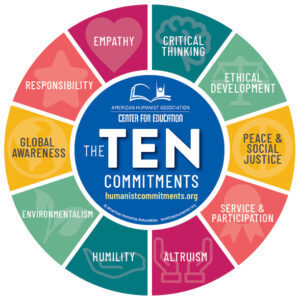
 This life, in this world, is our central defining focus. Each one of us is responsible for the collective welfare of humanity, other beings, and the resources of our shared planet. We value freedom, reason, and tolerance, and it is our responsibility to develop this heritage for ensuing generations. The Ten Commitments represents our shared humanistic values and principles that promote a democratic world in which every individual’s worth and dignity is respected, nurtured, and supported, and where human freedom and ethical responsibility are natural aspirations for everyone.
Love the Ten Commitments? Order our new posters and put your humanist values on display!
Ten Commitments materials order form (posters and badges).
Ten Commitments Text (Printable PDF Download)
Ten Commitments Workbook for Children (Printable PDF Download)
We celebrated World Humanist Day 2021 with article series on the Ten Commitments!
Download the Ten Commitments artwork
The 10 Commitments “wheel” is free to use, share, and adapt. High resolution files suitable for print and digital publications are available on our Artwork Page.
Altruism
“I will help others in need without hoping for rewards.”
Altruism is the selfless concern for the welfare of other living beings without expectation of reward, recognition, or return. The collective welfare of our communities and society depends on the welfare of each individual person. We should always seek to alleviate the suffering and hardships of others with compassionate action. By caring for others around us and lifting each other up, we reinforce healthy connections and contribute to the betterment of our community, society, and the world.
Critical Thinking
“I will practice good judgment by asking questions and thinking for myself.”
As we are each bombarded with a constant stream of information, it can become challenging to decide what is accurate and true. Thinking critically allows us to make sense of all this information and reason our way to good judgments and effective solutions to the problems we face while rigorously avoiding pitfalls like rationalization, conformity, and stereotyping. This process forms the basis of the scientific method, which opens the door for new discoveries through hypothesizing and experimenting. Critical thinking is a skill that requires continued attention, practice, and reflection. Exercising our minds to build these skills enables us to challenge biases in ourselves and in others, paving the way for a fair, open-minded, and autonomous perspective that fosters a multicultural worldview.
Empathy
“I will consider other people’s thoughts, feelings, and experiences.”
Empathy means entering imaginatively into another’s situation in an attempt to understand their experience as though we are experiencing it ourselves. Empathy requires us to step outside of our own perspective to consider someone else’s thoughts, feelings, or circumstance from that person’s point of view. In many ways, empathy is the first step to ethical behavior as it allows us to respond compassionately to the suffering of others and exercise good judgment when our actions may affect someone else. Understanding another’s perspective is not only critical to building better relationships, but also makes us better citizens in our local and global communities. Empathy promotes tolerance, consideration, and compassion amongst us all.
Environmentalism
“I will take care of the Earth and the life on it.”
Regardless of our individual identities, we all share the same home: planet Earth. Just as we depend on the planet to sustain us with its precious resources, this planet’s ecosystems depend on us to be good stewards and take responsibility for the impact human activity has on our shared planet. Disregard for the large-scale impacts humans have on our environment has caused extensive harm to earth’s ecosystems. Despite this, humanity is also capable of positive environmental change that values the interdependence of all life on this planet. Each of us must acknowledge our collective and individual mistakes, repair past damages, and purposefully work toward cultivating rich, diverse, and resilient ecosystems.
Ethical Development
“I will always focus on becoming a better person.”
The key to understanding ethical development is acknowledging that nobody is perfect or has all the answers. Ethical development is a never-ending process that requires constant reflection and evaluation of our personal choices and the consequences they have on others. Fairness, cooperation, and sharing are among the first moral issues we encounter in our ethical development as human beings and are often embraced intuitively, but each new day carries with it new challenges and new moral dilemmas. We should continually adapt and rebuild our moral frameworks with the goal of becoming ever better human beings.
Global Awareness
“I will be a good neighbor to the people who share the Earth with me and help make the world a better place for everyone.”
We live in a world that is rich in cultural, social, and individual diversity—a world with rapidly increasing interdependence. As a result, events anywhere are more likely to have consequences everywhere. Global awareness broadens our knowledge of cultures and perspectives that are outside of our own experience. A true global awareness includes attention to both current and historical events, and acknowledges how we affect—and how we are affected by—the interconnected social, political, and economic systems in which we reside. The end-goal of global awareness is global citizenship, which recognizes our personal responsibility to foster a healthy and dignified life for everyone in our global community.
Humility
“I will be aware of my strengths and weaknesses, and appreciate the strengths and weaknesses of others.”
Humility means displaying modesty about accomplishments, talents, gifts, or importance of self. It acknowledges we humans are fallible and have limitations in what we know and can do. Being humble isn’t about having low self-esteem or denigrating oneself. Humility at its core is robust self-awareness—awareness of our strengths and weaknesses, our faults and our merits. Humility involves setting aside personal pride and overcoming our egos to embrace gratitude for what we have and appreciate others for who they are. In being humble, we recognize our own value in relation to others; inherently, we are neither better nor worse than anyone else.
Peace and Social Justice
“I will help people solve problems and handle disagreements in ways that are fair for everyone.”
True peace involves an intense commitment to social justice and affirms the human rights and personal autonomy of all people. Any level of injustice against groups or individuals signifies existing conflict, even if the conflict isn’t immediate or obvious. We attain peace only by consistently responding to injustice through thoughtful conflict resolution that aims to repair harms and ensure a fair and equitable society moving forward. This kind of conflict resolution is known as restorative justice. In order to achieve a just, peaceful society, we all must take claims of injustice seriously and ensure that those who are impacted most by rights-violations determine the best course forward.
Responsibility
“I will be a good person—even when no one is looking—and own the consequences of my actions.”
Every day, each of us makes choices. These choices, large and small, all have consequences—for ourselves and for the world around us. Moral responsibility involves taking conscious ownership of one’s intentions and actions, and being accountable for the resulting consequences. Although we all live in a society with various cultural values, expectations, codes of conduct, and social mores, ultimately we all decide for ourselves what is right and wrong. Being a responsible person involves steadfast attention to what is right and willfully bearing the blame or praise for our own actions.
Service and Participation
“I will help my community in ways that let me get to know the people I’m helping.”
Service and participation means putting values into action in ways that positively impact our communities and society as a whole. It fosters helping others, increasing social awareness, enhancing accountability, and many attributes of the other nine commitments. Engaging in service doesn’t just make the recipients better off, but those who serve can develop new skills, experiences, and personal satisfaction that all promote personal growth. We must all recognize that we are members of a group, and engaging in service to benefit the group and the other individuals in it makes us all better off.